Xinkai Zou*, Yiming Huang*, Zhuohang Wu, Jian Sha, Nan Huang, Longfei Yun, Jingbo Shang†, Letian Peng†
* Equal contribution. † Corresponding authors.
TL;DR:
- We propose the task of simulating organized group behaviors: Given a group facing a particular situation, the task predicts the decision it would make.
- We also present GROVE, a benchmark for this task collected from the real-world data (Wikipedia and TechCrunch) containing 44 entities.
- We propose a framework converting collective decision-making events into interpretable, adaptive, and traceable behavioral models, outperforming summarization and retrieval-based baselines. The approach includes an adapter mechanism for time-aware evolution and group-aware transfer, plus traceable evidence nodes grounding each decision rule in originating historical events.
- Analysis on temporal behavior drift and cross-group similarity as well as behavior transfer
Update: this work is accepted by COLM 2026🎉
Interactive Demo
Explore how the our framework works on real entities. Select an entity below to load its interactive behavior model visualization.
How to use
- Navigate: drag to pan, scroll to zoom in/out
- Switch views: top-left controls toggle between base CDT and adapted trees (orange = modify, green = add, red = delete)
- Inspect: click a node to see its statements; click a statement to see supporting / opposing events
- Cases: purple nodes compare base vs adapted predictions on a single event
- Collapse: double-click a node to collapse / expand its sub-tree
Motivation
Organized groups — corporations, governments, institutions — make collective decisions that shape markets, policies, and societies. If we can simulate how a group behaves in a given situation, we can forecast and plan without real-world trial-and-error.
Concrete examples:
- Market forecasting: how would OpenAI respond to a new TML product launch?
- Policy analysis: how would the U.S. Senate vote on a proposed climate bill?
- Scenario planning: how would NATO act in response to a territorial incursion?
GROVE Benchmark
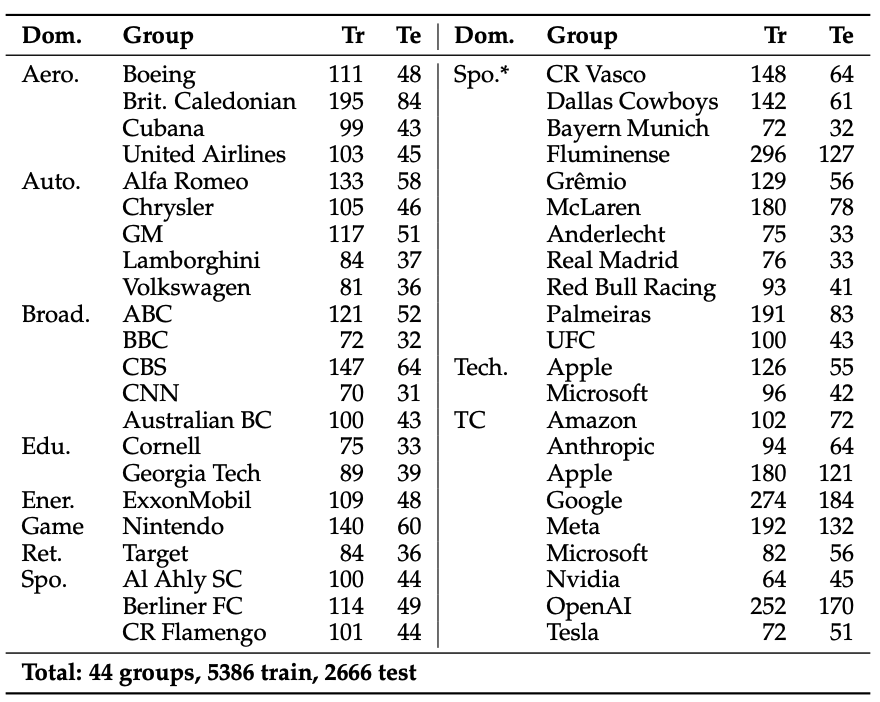
GROVE (GRoup Organizational BehaVior Evaluation) collects 8,052 real-world context-decision pairs from Wikipedia and TechCrunch, covering 44 entities across 9 domains (technology, finance, politics, automotive, etc.). Each instance pairs a real situation a group faced with the actual decision it made.
Framework
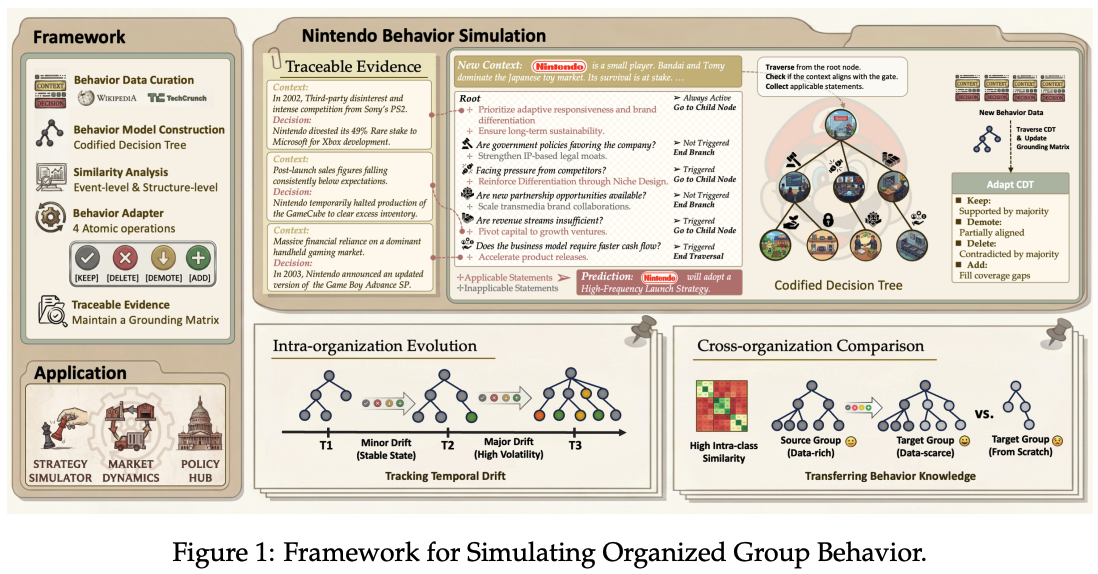
Rather than retrieving similar past events or summarizing them, we convert a group’s history into a structured behavioral model: each rule is grounded in specific historical events (traceable evidence nodes), so every prediction is auditable. Two adapters extend the model:
- Time-aware adapter — captures how a group’s behavior evolves over time
- Group-aware adapter — transfers behavioral knowledge from data-rich groups to data-scarce ones
Analysis
1. Temporal Behavior Drift
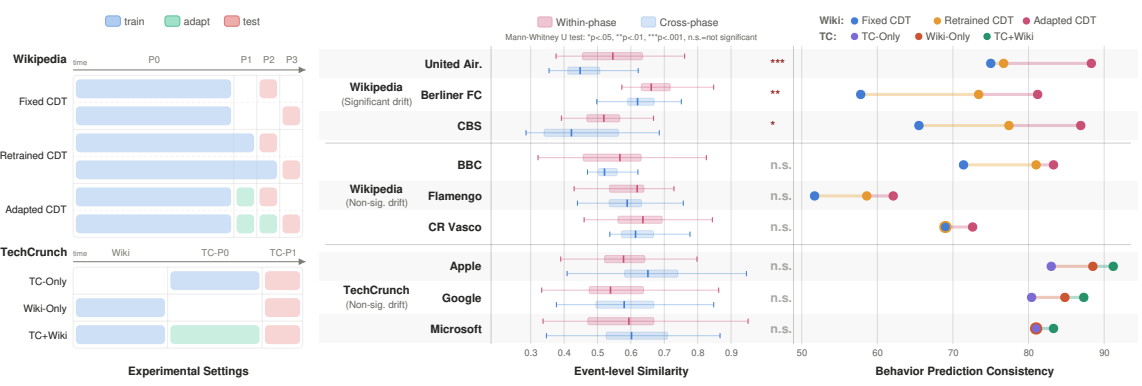
Groups don’t behave the same way forever — their priorities, risk tolerance, and strategies shift over years. The time-aware adapter detects these drifts and produces stronger predictions for recent decisions than a static model can.
2. Group Similarity and Behavior Transfer
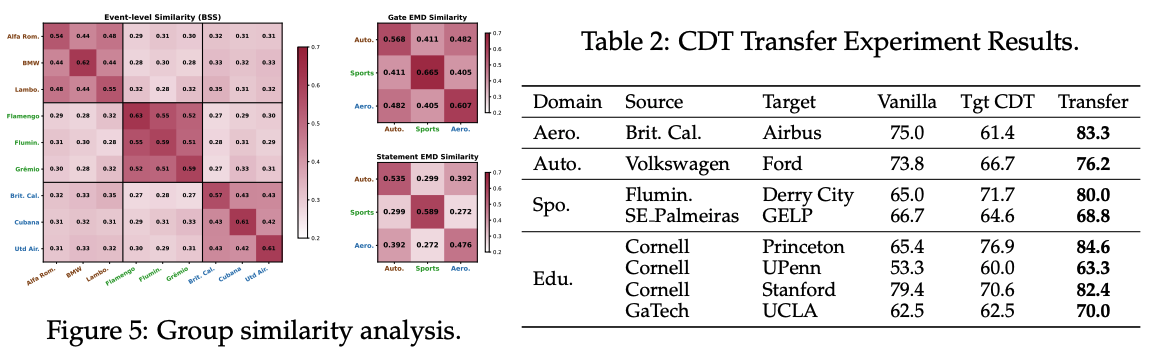
Groups cluster by structural similarity (e.g., tech giants behave more like each other than like banks). This means behavioral rules learned from a well-documented group can transfer to a similar but data-scarce one — giving us useful predictions even for entities with limited history.
Citation
@article{zou2026simulating,
  title={Simulating Organized Group Behavior: New Framework, Benchmark, and Analysis},
  author={Zou, Xinkai and Huang, Yiming and Wu, Zhuohang and Sha, Jian and Huang, Nan and Yun, Longfei and Shang, Jingbo and Peng, Letian},
  journal={arXiv preprint arXiv:2604.09874},
  year={2026}
}